

Dercum’s disease, also called adiposis dolorosa, is a rare condition whose defining feature is chronic pain in the fatty tissue under the skin. It was first described in the 1890s by the American neurologist Francis Xavier Dercum, and more than a century later much about it remains unsettled — including what causes it.
What Dercum’s Disease Is
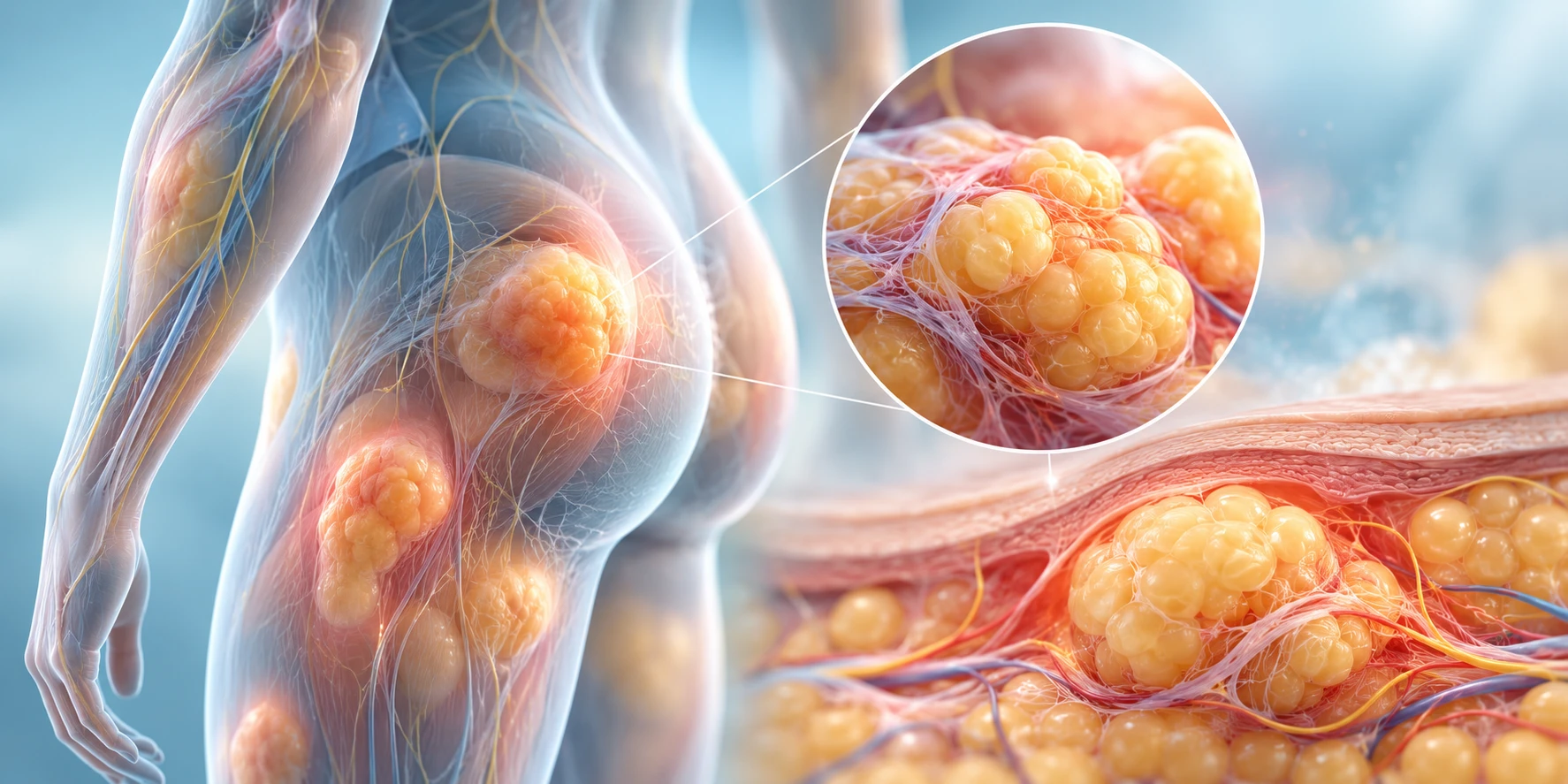
People with the condition develop painful areas of subcutaneous fat, often in the form of soft lumps or more diffuse thickened tissue. These are commonly described as lipomas, though the pain is what distinguishes them: ordinary lipomas are usually painless, and many people have them without ever noticing.
The affected areas most often appear on the trunk, upper arms, thighs and around the knees, though they can occur more widely. Clinicians have proposed several patterns — widespread and diffuse, widespread with distinct nodules, localised nodules, or tissue clustered around the joints — but these categories describe how the condition presents rather than explaining it.
The Pain That Defines It
Pain is the symptom that brings most people to a diagnosis, and it is frequently described as burning, aching or pressure-like. It can be constant or come in episodes, and it is often reported as being out of proportion to how the affected tissue looks or feels to someone else. Pressure on the area — from clothing, from sitting, from a routine physical examination — can be enough to provoke it.
That mismatch between visible signs and reported pain is one reason the condition is so often missed or dismissed. Many people describe long delays before anyone names what they are experiencing, and being told the pain is unexplained is a common part of the account.

Symptoms Beyond Pain
Pain is rarely the only symptom. People living with the condition frequently report:
- Persistent fatigue that rest does not resolve
- Disturbed sleep, often because of pain
- Difficulty with concentration and memory
- Swelling, and a tendency to bruise easily
- Joint and muscle discomfort, and reduced mobility
How much any individual experiences varies considerably, and these symptoms overlap with several other conditions — which is part of why reaching a diagnosis can take so long.
What Causes It, and What Is Still Unknown
There is no established cause. Several lines of thinking have been explored: that the nerves supplying the affected tissue process pain abnormally, that inflammatory activity in adipose tissue plays a part, that the lymphatic system or connective tissue is involved, or that endocrine factors contribute. Cases occurring within families have been reported, which has prompted interest in whether some people are genetically predisposed.
None of these explanations is settled, and they are not mutually exclusive. It remains possible that what is currently described as one condition turns out to cover more than one underlying process.
How It Is Diagnosed
There is no blood test, scan or biopsy that confirms Dercum’s disease. Diagnosis is clinical: a doctor takes a history, examines the painful tissue, and rules out other explanations for the symptoms. Imaging is sometimes used to look at the tissue itself, but it is used to build the picture rather than to settle the question.
Because diagnosis depends on exclusion and on the clinician recognising the pattern, and because the condition is rare, many people see several practitioners before it is identified.
How It Is Managed
There is currently no cure, and no treatment is established as reliably effective for everyone. Management is symptomatic and usually involves more than one approach — pain management, physical and occupational therapy to protect mobility, attention to sleep, and support for the psychological weight of living with a chronic painful condition.
Surgical removal of particularly painful lipomas is sometimes considered. Reported results are mixed, and pain returning in the same or nearby areas is a recognised possibility, so it is a decision made case by case with a specialist.
Why So Much Remains Open
Dercum’s disease is under-researched relative to its impact. It is uncommon, which makes assembling large study groups difficult; it has no single diagnostic test, which makes defining a study population difficult; and its main symptom is pain, which is subjective and hard to measure consistently. Those three problems reinforce one another, and they are a large part of why the evidence base is thinner than patients need it to be.
If you recognise these symptoms in yourself, the most useful step is a conversation with a healthcare professional who can assess you properly. This article is general information about a medical condition and is not a substitute for individual medical advice.